Lecture 7 | Module 2: Platform Mastery
FA Facilitator Oct 28, 2026 20 pages 1 view PPTX
Free preview: 3 of 20 pages
Paid
Pages 4 to 20 are for buyers
Buy once and read it in full on any device, any time.
Freelancing Mastery Course - 30 Complete Lectures (6 Modules)
8 documents in this bundle
$49.00
$19.00
Get full access
Bought it already? Log in to read.
About this document
Attach relevant portfolio samples. 4 Client Reviews: Client shortlists top proposals. Client reaction: This was copy-pasted to 50 other jobs. Complete your Upwork profile 100%: professional title, full overview using 5-part structure, skills with tests taken, hourly rate set, portfolio samples added.
Document text
T H E F A C I L I T A T O R S A C A D E M Y
Lecture 7 | Module 2: Platform Mastery
Upwork
Profile &
Proposals
Build a profile clients trust and write
proposals that actually get responses
Duration: 60–70 minutes • Open Upwork on your laptop
Supervised by: Muhammad Sohail Ashraf
20+ Years Freelancing Experience
The Facilitators Academy • Lecture 7: Upwork Profile & Proposals • thefacilitators.net • +92 304 5224838
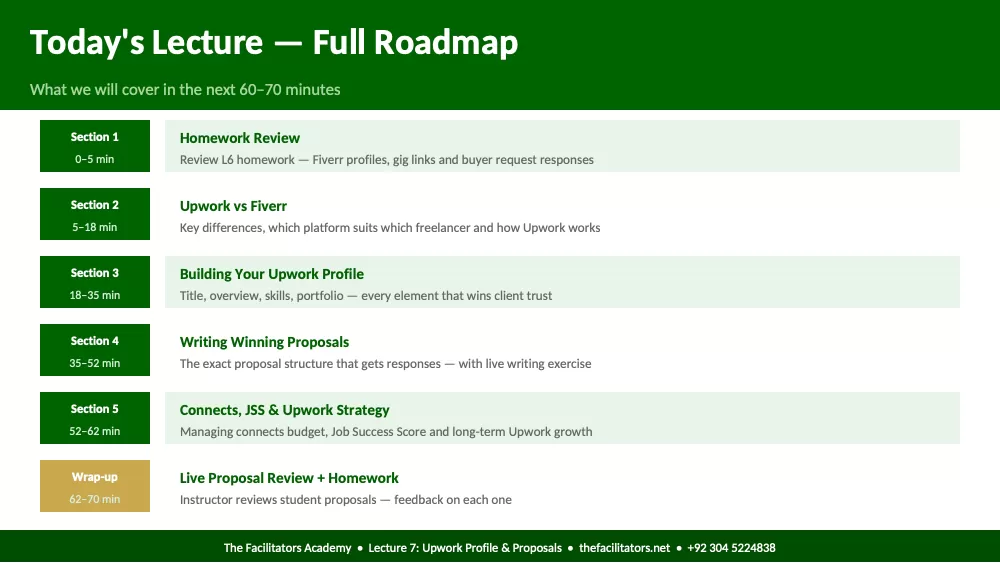
Today's Lecture — Full Roadmap
What we will cover in the next 60–70 minutes
Section 1
0–5 min
Homework Review
Review L6 homework — Fiverr profiles, gig links and buyer request responses
Section 2
5–18 min
Upwork vs Fiverr
Key differences, which platform suits which freelancer and how Upwork works
Section 3
18–35 min
Building Your Upwork Profile
Title, overview, skills, portfolio — every element that wins client trust
Section 4
35–52 min
Writing Winning Proposals
The exact proposal structure that gets responses — with live writing exercise
Section 5
52–62 min
Connects, JSS & Upwork Strategy
Managing connects budget, Job Success Score and long-term Upwork growth
Wrap-up
62–70 min
Live Proposal Review + Homework
Instructor reviews student proposals — feedback on each one
The Facilitators Academy • Lecture 7: Upwork Profile & Proposals • thefacilitators.net • +92 304 5224838
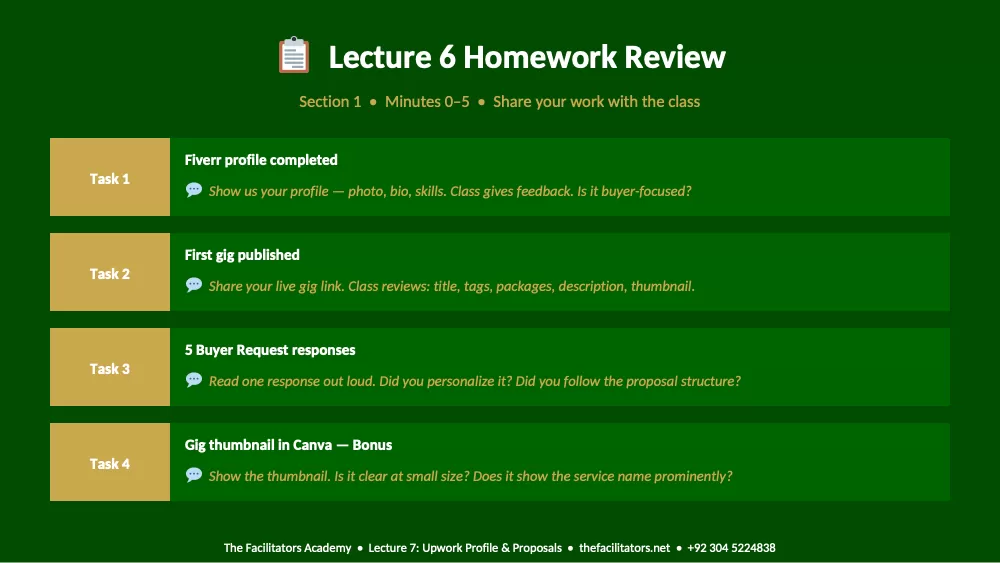
Lecture 6 Homework Review
Section 1 • Minutes 0–5 • Share your work with the class
Task 1
Fiverr profile completed
Show us your profile — photo, bio, skills. Class gives feedback. Is it buyer-focused?
Task 2
First gig published
Share your live gig link. Class reviews: title, tags, packages, description, thumbnail.
Task 3
5 Buyer Request responses
Read one response out loud. Did you personalize it? Did you follow the proposal structure?
Task 4
Gig thumbnail in Canva — Bonus
Show the thumbnail. Is it clear at small size? Does it show the service name prominently?
The Facilitators Academy • Lecture 7: Upwork Profile & Proposals • thefacilitators.net • +92 304 5224838
Section 2
Upwork vs Fiverr
Minutes 5–18 • Key differences and which platform suits which freelancer
The Facilitators Academy • Lecture 7: Upwork Profile & Proposals • thefacilitators.net • +92 304 5224838
Upwork vs Fiverr — Know the Difference
Both are legitimate income paths — but they work very differently
Factor Fiverr Upwork
Business Model Buyers browse and buy your gigs Clients post jobs — you apply with proposals
Who initiates Buyer finds YOU and clicks your gig YOU find jobs and send proposals to clients
Payment Model Fixed gig prices you set Hourly or fixed price — client sets budget
Competition Compete with millions of gig thumbnails Compete with proposals for specific jobs
Client Quality Mix — many small one-time buyers Higher — businesses looking for long-term help
Fees Fiverr takes 20% of every order Upwork takes 20% (drops to 10% after $500 with client)
Entry Barrier Low — anyone can create gigs immediately Medium — needs approved profile and connects budget
Best for Beginners, product-style services, speed Professionals, long-term clients, higher budgets
Income potential $5 to $500 per gig typically $500 to $5,000+ per contract typically
The Facilitators Academy • Lecture 7: Upwork Profile & Proposals • thefacilitators.net • +92 304 5224838
How Upwork Works — The Complete Flow
Understanding the platform mechanics before you build your profile
On Upwork, YOU are the one applying. Every job post is a competition. The freelancer with the most relevant, personalized and
professional proposal wins — not the cheapest one.
1 Client Posts Job: A business owner posts a job with description, budget and requirements. Hundreds of freelancers see this posting.
2 You Find the Job: Browse job feed filtered by your niche, skills and experience level. Search by keyword, budget and client history.
3 You Send Proposal: Write a personalized cover letter. Spend Connects (Upwork's currency) to apply. Attach relevant portfolio samples.
4 Client Reviews: Client shortlists top proposals. They check your profile, portfolio, JSS score and reviews before deciding who to
interview.
5 Interview / Chat: Client messages shortlisted freelancers. This is your chance to demonstrate expertise and build rapport before
hiring.
6 Contract Begins: Client sends offer. You accept. Work begins. Milestones or hourly tracking starts. Payment protected by Upwork
escrow.
The Facilitators Academy • Lecture 7: Upwork Profile & Proposals • thefacilitators.net • +92 304 5224838
Section 3
Building Your Upwork Profile
Minutes 18–35 • Title, overview, skills and portfolio
The Facilitators Academy • Lecture 7: Upwork Profile & Proposals • thefacilitators.net • +92 304 5224838
Profile Title & Overview — Your Most Important Real Estate
Clients see your title in search results and your overview decides if they click 'Invite to Job'
Professional Title Rules
Maximum: 50 characters Formula: [Skill] Specialist | [Niche] Expert Good
examples: ✓ Facebook Ads Specialist | eCommerce Growth ✓ Virtual
Assistant | Admin & Email Management ✓ Amazon PPC Expert | Product
Launch Specialist ✓ Social Media Manager | Content & Engagement ✓ AI
Content Specialist | ChatGPT & Automation Bad examples: ✗ 'I am a
hardworking freelancer' ✗ 'Expert in everything' ✗ 'New but willing to
learn' ✗ Leaving it blank Rule: Your title must contain the exact keyword
clients search on Upwork.
Overview Writing Formula
First 2 lines are critical — clients see these in search before clicking. 5-Part
Structure: 1. Hook — Start with client's problem or goal 2. What you do —
specific service, not vague claim 3. Your experience — specific numbers or
results 4. What client gets — deliverables and benefits 5. Call to action —
invite them to message you Example opening (STRONG): "Struggling to get
results from your Facebook ads? I help eCommerc
Showing the first pages. Read the full document above.
Comments (0)
Log in to join the discussion.